






The company is part of a Finnish holding group with extensive operational experience across the European Union and Central Asian transit markets.
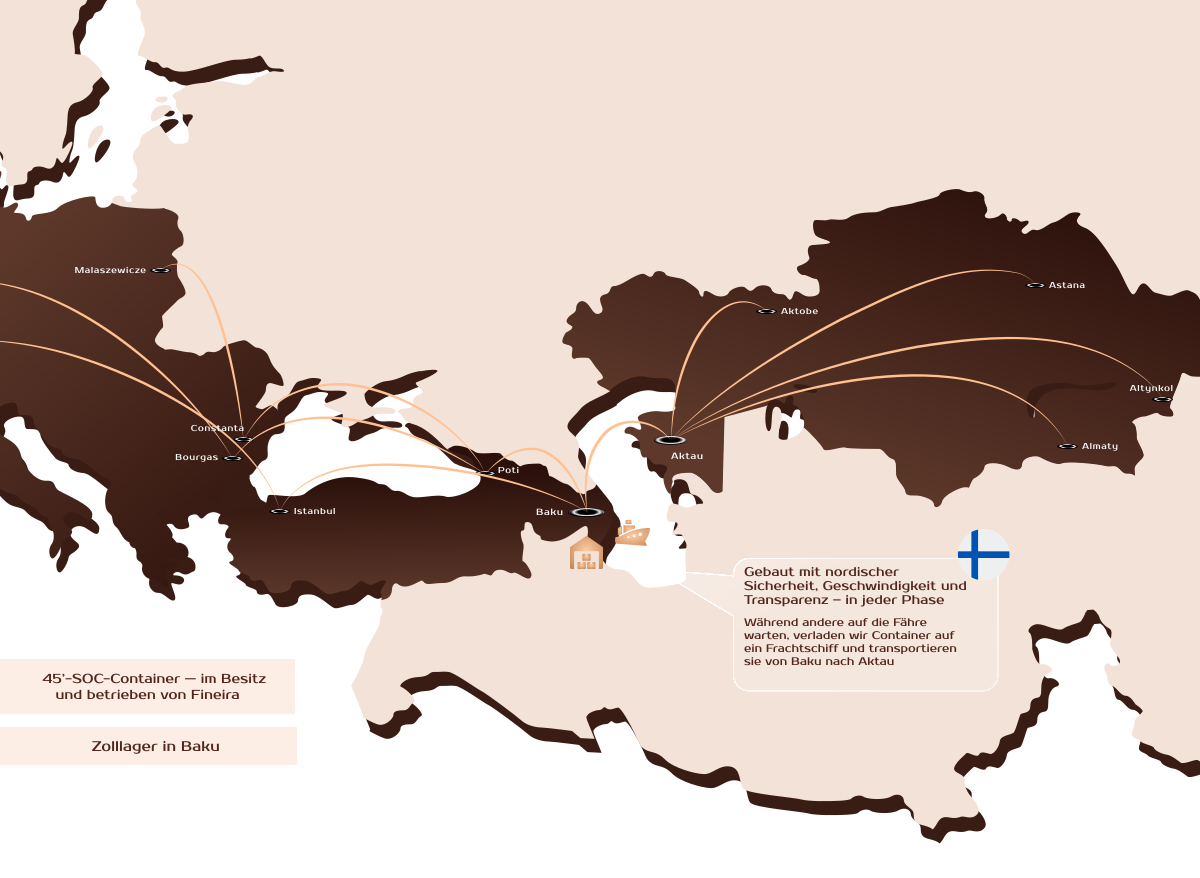
Fineira operates a bonded warehouse and container handling facilities in Baku, Azerbaijan, providing controlled transit, storage, and cargo processing services.
Our solutions are designed specifically for the Trans-Caspian corridor and do not rely on northern transit routes.
Read more…
Multimodal Freight Solutions via the Trans-Caspian Corridor
Multimodal freight solutions are designed to move cargo efficiently across long and complex routes by combining road, rail, sea, and ferry transport into one coordinated logistics chain. In the Trans-Caspian corridor, this approach is not an option but a necessity. Fineira provides multimodal freight solutions that connect Europe, the Caucasus, and Central Asia through a controlled, predictable, and operationally transparent transit model, minimizing delays and reducing dependency on single transport modes.
All multimodal freight solutions provided by Fineira are routed exclusively through the Trans-Caspian corridor and Central Asian infrastructure. The company does not operate transit routes through the Russian Federation and does not rely on Russian transport infrastructure.
Multimodal Freight Solutions Connecting Europe, the Caucasus, and Central Asia
Multimodal freight solutions play a critical role in trade flows between Europe and Asia, especially along the Trans-Caspian corridor. Geography alone makes single-mode transport inefficient. Cargo must pass rail terminals, ports, ferries, and inland hubs before reaching its final destination.
In practice, Fineira builds routes that link European logistics centers such as Vienna, Duisburg, Hamburg with key transit nodes in Baku, Aktau, Altynkol, and Almaty. Each segment is planned as part of one system rather than isolated transport legs. This integrated approach reduces idle time at borders and terminals.
Based on operational data from recent years, properly designed multimodal freight solutions can shorten overall transit time by 10–20% compared to fragmented shipping models, especially during peak seasons or infrastructure disruptions.
Multimodal Freight Solutions with SOC Containers and Bonded Warehouse
A key advantage of Fineira’s multimodal freight solutions is the use of 45’ SOC containers owned and operated directly by the company. This eliminates dependency on third-party container pools and significantly improves equipment availability during high-demand periods.
In addition, Fineira operates a bonded warehouse in Baku, which functions as a strategic control point along the corridor. From an operational perspective, this enables:
- temporary bonded storage without immediate customs clearance,
- cargo consolidation and deconsolidation,
- cross-docking between transport modes,
- preparation for onward transit without unnecessary delays.
In real operating conditions, the presence of a bonded warehouse reduces dwell time at the Caspian segment by an average of 2–4 days, depending on cargo type and seasonality.
Multimodal Freight Solutions Optimized for the Trans-Caspian Corridor
The Trans-Caspian corridor is dynamic. Ferry schedules, weather conditions, rail capacity, and port congestion change constantly. Effective multimodal freight solutions must adapt in real time.
Fineira optimizes each route by monitoring:
- Caspian Sea ferry availability,
- port throughput in Baku and Aktau,
- rail terminal capacity in Kazakhstan,
- border processing timelines.
Instead of fixed theoretical schedules, routes are adjusted based on current operational conditions. This flexibility is one of the main reasons why multimodal freight solutions outperform rigid transport chains in this region.
Multimodal Freight Solutions for Eastbound and Westbound Transport
Eastbound and westbound cargo flows require different operational logic. Eastbound shipments typically prioritize speed and synchronization, while westbound transport often requires tighter documentation control and buffer planning.
Fineira’s multimodal freight solutions account for these differences. Eastbound cargo frequently moves via accelerated rail-ferry combinations through Baku–Altynkol, while westbound shipments are routed through flexible European terminal windows to avoid congestion.
Multimodal Freight Solutions for FTL and FCL Shipments
Fineira supports both FTL and FCL within its multimodal freight solutions. This includes:
- full container shipments for industrial and commercial cargo,
- dedicated containers for project logistics,
- optimized container loading based on weight, dimensions, and securing requirements.
This flexibility allows clients to scale shipments without redesigning the logistics model for every order.
Multimodal Freight Solutions with Integrated Warehouse Handling
Warehouse operations are not a separate service but an integrated element of multimodal freight solutions. Handling operations include unloading, reloading, temporary storage, labeling, and cargo preparation for the next transport leg.
This integration reduces handover risks and improves accountability across the entire logistics chain.
What Is Included in Multimodal Freight Solutions
| Component | Description |
| Route planning | End-to-end transit optimization |
| Containers | 45’ SOC containers under Fineira control |
| Storage | Bonded warehouse operations in Baku |
| Transport modes | Road, rail, sea, ferry |
| Monitoring | Continuous tracking and coordination |
How to Choose Multimodal Freight Solutions
When selecting multimodal freight solutions, we recommend focusing on:
- Ownership or direct control of equipment,
- Proven operational experience on the corridor,
- Availability of bonded storage,
- Transparency of transit stages and timelines.
In practice, these factors matter more than headline transit times.
How Much Do Multimodal Freight Solutions Cost
The cost of multimodal freight solutions varies depending on route, cargo type, season, and urgency. Pricing typically starts from a base level but is adjusted according to real operating conditions.
In most cases, individual route calculation provides better cost efficiency than standard tariffs, especially for regular or high-value cargo.
Frequently Asked Questions (FAQ)
- How long does transit usually take?
On average, 18–30 days depending on route and seasonal conditions. - Is cargo tracking available?
Yes, shipments are monitored at each stage of the route. - Do you handle special cargo?
Yes, including ADR, temperature-sensitive, and high-value goods.
Why Clients Choose Fineira
Clients choose Fineira for multimodal freight solutions because of:
- specialization in the Trans-Caspian corridor,
- ownership of SOC containers,
- bonded warehouse presence in Baku,
- European operational management,
- focus on predictable and controllable logistics.
Stages of Work
- Cargo analysis and requirements assessment.
- Route design and optimization.
- Equipment and schedule allocation.
- Transport execution and monitoring.
- Delivery and operational closure.
Advantages and Operational Guarantees
Fineira does not promise unrealistic transit times. Instead, multimodal freight solutions are built around process control and transparency. Clients always know where the cargo is and what happens next, which in practice is more valuable than theoretical speed claims.
Request Multimodal Freight Solutions
If you are looking for multimodal freight solutions through the Trans-Caspian corridor with predictable transit, controlled handling, and real operational oversight, request a route calculation. We will propose a practical logistics solution based on current conditions, not assumptions.

Website promotion SEOEXPERT